
Operational outcome
Job visibility across every job
See what is happening with every job, what is waiting, and what needs attention without chasing people for updates.
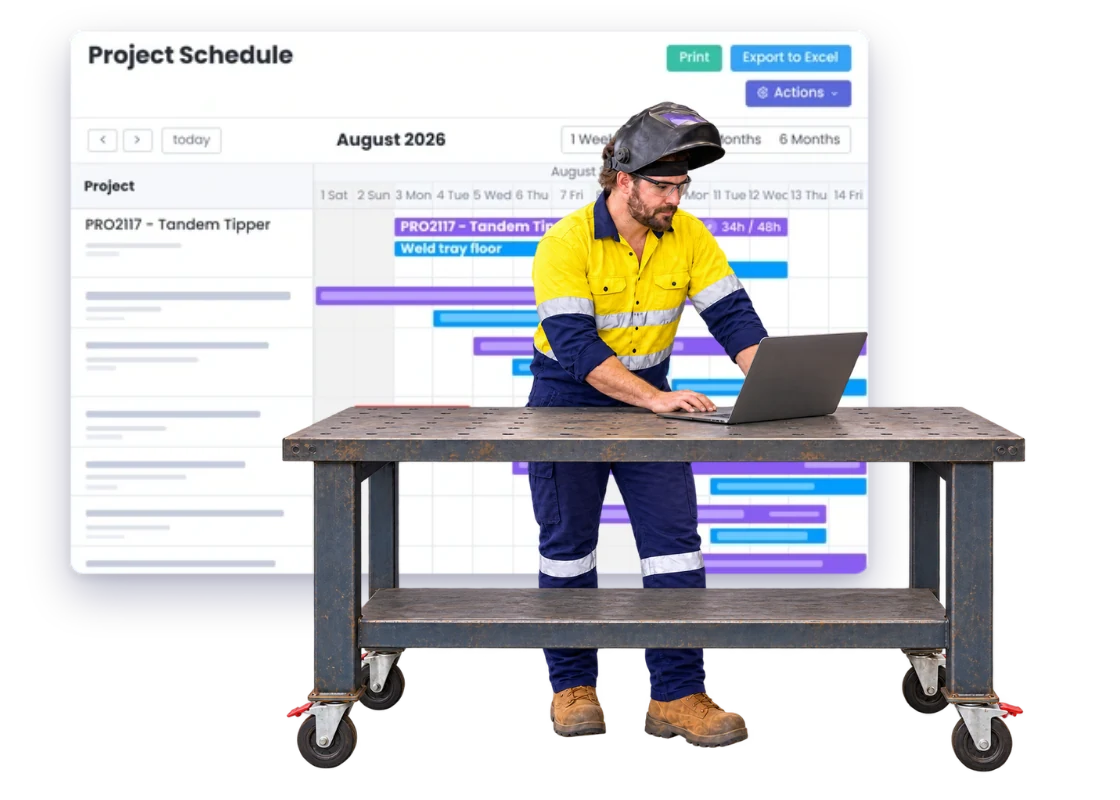
Without it
The job is moving. The information is not.
When updates live in conversations, whiteboards and people’s heads, getting a straight answer takes longer than it should.
You have to ask where the job is at.
The answer depends on finding the person who knows what happened last.
Everything says it is in progress.
That does not tell you what is done, what is waiting or what is holding it up.
The office and workshop know different things.
One side has the customer update. The other knows what is actually happening on the floor.
A delay is obvious only after it hurts.
The job has been waiting on material or approval, but nobody joined the dots early enough.
The customer rings before you know the answer.
Now the update starts with a round of calls instead of a clear view of the job.
The history disappears once the job is done.
Months later, working out what happened means digging through emails, messages and memory.
What good looks like
You can open the job and answer the question without chasing the workshop, site crew or office.
With it
Open the job and get the answer.
Good job visibility is not about watching every move. It is about keeping the important updates with the job so the next question has a clear answer and the next person knows what needs attention.
Where is this job up to?
See what is done, underway and still outstanding.
What are we waiting on?
See the hold-up instead of finding it by accident.
Who is working on it?
See the people connected to the job and its tasks.
What changed since we quoted it?
Keep the current job visible, not just the original plan.
What happened on this job?
Look back at the job history when the question comes later.
How you get there
Keep the job current as the work moves.
Nothing here is a separate exercise. It is the same job record, kept current as the work moves.
01
Set up the job
02
Add the work
03
Put people on it
04
Keep updates with it
05
Record what changes
06
See what is waiting
07
Finish the work
08
Keep the history
The parts doing the work
What delivers it
These are the features this leans on. Each has its own page if you want the detail.
Project Management
Keep the people, hours, costs, documents and changes with the job from start to finish.
Task Management
Break bigger jobs into tasks so the team knows what’s next and you know what’s been done.
Proof
What it looks like in a real workshop
-
We didn’t wanna pay 100 grand upfront for a program – but then we found WorkGuru.
Nick Mazzella, Administrator, Frontline Trays & Trailers
Fit
Do we really need more job tracking?
You do not need more admin for the sake of it. You need enough shared information that the job does not depend on one person’s memory.
“Our jobs are all different.”
That is fine. Visibility is about seeing the job you actually have, not forcing every job into the same shape.
“The workshop already knows what is going on.”
Good. The aim is to make that picture available to the people who need it without another round of questions.
“We do plenty of quick jobs.”
Keep quick jobs simple. Add more detail only where the size or risk of the job makes it useful.
“We do not want people updating software all day.”
They should not. Keep the important job information current, then get back to getting the job done.
Who feels this most
The trades that ask for this first
These are the industries where this comes up in almost every conversation. Pick the one closest to yours.
Next door
Usually asked for together
These lean on the same parts of WorkGuru, so businesses chasing one normally want the other.
Faster Invoicing
Invoice off what was recorded on the job, so nothing gets missed and nothing sits waiting.
Workshop Visibility
Know what is on the floor, what is waiting, and what is holding things up.
Workshop Scheduling
Put work in front of the right people in the right order, and move it when things change.
FAQs
Job Visibility questions
What does job visibility mean in a workshop business?
It means being able to see where a job is at, what is outstanding and what is holding it up without chasing people.
How do I keep track of jobs across office and workshop?
Keep the important job, task, time, document and update information together so both sides work from the same job.
Can job visibility work for both small and large jobs?
Yes. Small jobs can stay simple, while larger projects can carry more tasks, people, costs and job information.
How can I tell what is holding a job up?
Keep current job information visible so waiting material, approvals, people or other dependencies are easier to spot.
Does better job visibility mean more admin for the team?
It should not. The goal is to record the useful information once so fewer people have to chase the same update later.
Can I look back at what happened after a job is finished?
Yes. Keeping job information and history together gives you a clearer record when questions come back later.
See it on one of your own jobs.
Bring us a real job and we will show you how WorkGuru keeps the important updates together from start to finish.