
Home / Features / Inventory & Stock Control / Counter Sales / Stock Sales
Inventory & Stock Control
Sometimes it is a sale, not a job.
Sell something over the counter, take the stock off the shelf and invoice it — without raising a job for it.
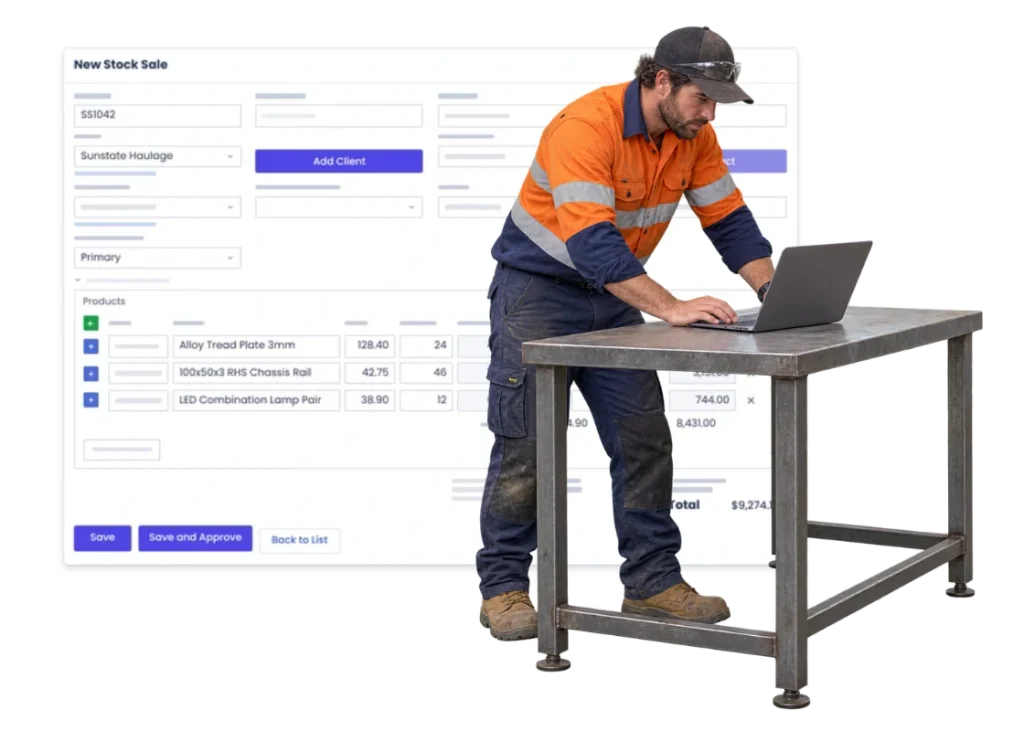
Overview
Not every customer needs a project.
Not everything that leaves the workshop is a project. Somebody comes in for a length of section, a fitting, a part off the shelf. Raising a full project for that is more process than the transaction deserves, and it clutters your job list with things that aren’t jobs.
A stock sale in WorkGuru handles exactly that. It lets you invoice and dispatch products and services quickly without creating a project. There are two components to it: the invoicing, and the dispatch — which is the stock movement that takes the goods off your shelf.
Stock sales have product lines only. They don’t have tasks, and consequently they can’t capture timesheets. That’s the deliberate trade: if the transaction involves labour you need to record against it, it’s a project, not a stock sale. If it’s goods going out the door, a stock sale is faster.
Because dispatch is a real stock movement, the counter sale reduces stock on hand and records cost of goods sold the same way any other consumption does. Over-the-counter trade doesn’t quietly disappear from your inventory.
What’s inside
What you get
01
Direct stock sales
Sell products without a full project.
02
Customer connection
Keep the sale with the customer where useful.
03
Product selection
Use the same products managed in inventory.
04
Stock reduction
Update inventory when the item is sold.
05
Transaction history
Keep a record of what was sold.
06
Pricing connection
Use the product pricing setup behind the sale.
The reality
Why you need it
Stock leaves and the shelf never gets updated.
Someone takes an item, an invoice goes out from accounting, and the stock figure carries on as if nothing happened. Do that a few dozen times and the number is meaningless — which is usually discovered when a job stalls on something the system said you had.
Raising a project for a $40 sale feels ridiculous.
Because it is. So either somebody does it and your job list fills with things that aren’t jobs, or nobody does and the sale bypasses the system. Both outcomes are worse than having a transaction type built for it.
The counter sale gets invoiced but never costed.
Revenue lands and cost of goods sold doesn’t, so the margin on counter trade looks far better than it is. That is a pleasant error right up to the point where you make decisions on it.
A trade customer asks what they bought last month.
If those sales are scattered across accounting and memory, answering takes an afternoon. Against the client, it takes a moment — and it’s the sort of question that only ever comes from customers worth keeping.
How it works
How it works
01
Choose the customer
02
Choose the products
03
Confirm the quantity
04
Complete the sale
05
Reduce the stock
06
Keep the record
Capabilities
What it does
Capability
Direct stock sales
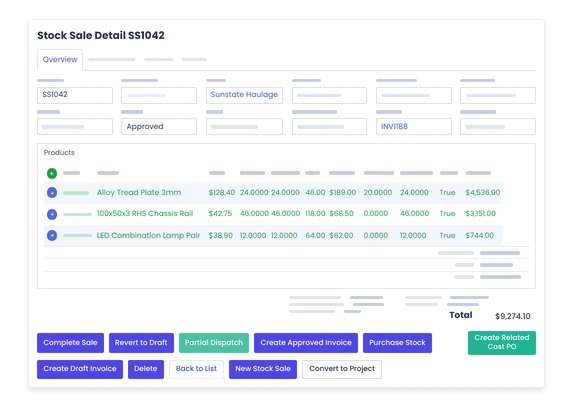
Invoice and dispatch products and services without creating a project. Stock sales carry product lines only — no tasks, and consequently no timesheets. That’s the deliberate trade: if the transaction involves labour you need recorded, it’s a project; if it’s goods going out the door, this is faster.
Capability
Customer connection
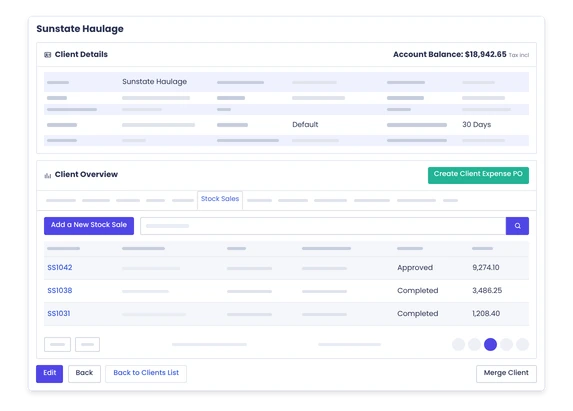
The sale is raised against a client, so it becomes part of their history alongside their quotes and projects. A regular trade customer’s counter purchases sit in the same place as their job work rather than in a separate ledger.
Capability
Product selection
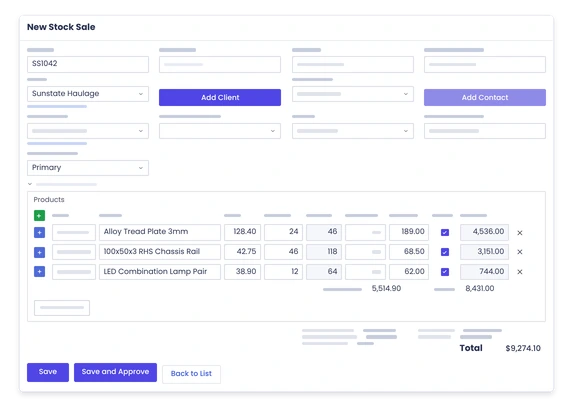
The same product list as everything else. A FIFO item dispatched on a stock sale draws from the same stock and is costed the same way as one consumed on a job, so you’re not maintaining a second catalogue for counter trade.
Stock reduction
Dispatch is the stock movement half of a stock sale. Dispatching reduces stock on hand and records cost of goods sold — which is the main reason to handle counter trade here rather than invoicing it from accounting, where the shelf never gets updated.
Transaction history
What went out, to whom, when and at what price. Small sales are the ones that most often vanish from the record entirely, and they’re also the ones that quietly account for a surprising share of stock movement.
Pricing connection
The client’s pricing tier applies to the sale, so a trade customer on contract rates gets them at the counter without anyone having to remember. The same applies to currency.
What you get out of it
What changes
Keep simple sales simple
Do not create project admin where there is no project.
Keep stock current
What is sold should leave the available quantity.
Keep customer history useful
See the direct product sales alongside the relationship.
Use one product list
Sell the same products you quote, buy and stock.
-
Discovered their contract work wasn’t profitable.
We didn’t wanna pay 100 grand upfront for a program – but then we found WorkGuru.
Nick Mazzella, Administrator, Frontline Trays & Trailers
Fit
Will it work the way we do things?
“We only do a few stock sales.”
Then they’ll take you very little time, and they’ll stop a handful of transactions either cluttering your project list or bypassing the system entirely. The second is the real risk — counter trade that never gets recorded is stock that walks off the shelf without a corresponding sale.
“Most customers come to us for jobs.”
That’s true of nearly every business using this. Stock sales aren’t a replacement for project work — they’re for the smaller share of transactions that are just goods. Having somewhere sensible to put those keeps your project list meaning something.
“We already invoice these from accounting.”
You can, and the invoice will be fine. What accounting won’t do is take the item off your shelf. Invoicing outside WorkGuru means the stock on hand stays wrong until somebody notices at the next count, and the cost of goods sold never lands against the sale.
“We do not run a retail store.”
Nor do most businesses using stock sales. It isn’t a point-of-sale system — it’s a way to handle goods leaving the business without a job attached. That happens in workshops constantly, whether or not there’s a counter.
By trade
Where this gets used
Works with
Connected features
Stock Control
Reduce inventory as products are sold.
Product Management
Use the same product records and pricing.
Client Management
Keep the sale with the customer.
Payments
Handle payment workflows where they apply.
Reporting
Review product sales and transaction history.
FAQs
Counter Sales / Stock Sales questions
What is a counter sale in a job-based business?
It’s a sale of goods without a project behind it — someone buying material or a part rather than commissioning work. In WorkGuru that’s a stock sale: product lines, invoiced and dispatched, with no tasks and no timesheets.
Does a counter sale reduce stock on hand?
Yes. Dispatch is the stock movement half of a stock sale, so dispatching reduces stock on hand and records cost of goods sold. That’s the main reason to handle counter trade in WorkGuru rather than invoicing it elsewhere.
Can counter sales be linked to customers?
Yes. Stock sales are raised against a client, so the sale becomes part of that client’s history alongside their quotes and projects. A regular trade customer’s purchases are visible in the same place as their job work.
Can we use the same products as our project work?
Yes, it’s the same product list. A FIFO product dispatched on a stock sale draws from the same stock and is costed the same way as one consumed on a job, so you’re not maintaining a separate set of items for counter trade.
Do we need to use counter sales for every small transaction?
No, and it’s worth deciding deliberately. The test is whether the stock movement matters. If the item is stock controlled and its accuracy affects whether a job can start, put it through. If it’s a genuinely trivial consumable you don’t track, it doesn’t need a transaction.
Is counter sales only for retail businesses?
No. It’s for any business where goods sometimes leave without a job attached — which is most workshops. The alternative is either raising a project for a $40 sale or letting it happen off the books.
Sell the part without creating a fake job.
Show us the kind of product sales you handle outside projects and we will show you the simpler WorkGuru path.