
Home / Industries / Boat Building
For boat builders
Job Management Software for Boat Builders
Keep long, detailed boat builds together from quote through purchasing, labour, changes and delivery.
- Local support, based in Brisbane
- Built for boat builders
- No lock-in contract
The reality
Boat builds have a lot of moving parts. Literally and otherwise.
No two jobs are exactly the same, but a few problems come up again and again.
The spec keeps growing.
Electronics, fit-out, engines, plumbing, paint and customer changes can all move after the quote.
A lot of the cost is bought in.
Engines, electronics, hardware and specialist work can make up a big chunk of the job.
Different trades are on the same boat.
Fabrication, electrical, fit-out, plumbing and finishing all need to roll back to one job.
One late component holds up three other things.
A missing engine, window or fitting can stop work around it.
Long builds hide small blowouts.
An extra couple of hours every week matters on a job that runs for months.
Customers change their mind.
The build needs to move with them without the extra work getting lost.
How it runs
Keep the job together from start to finish.
Same job record from the first quote through to the invoice. Nothing gets re-entered and nothing gets left in someone’s head.
01
Quote the build
02
Set up the project
03
Plan the stages
04
Order long-lead items
05
Build and fit out
06
Record labour and changes
07
Watch the job costs
08
Deliver and invoice
Proof
What it looks like in a real workshop
We are adding stories from boat builders. In the meantime, see how workshops like yours run WorkGuru.
Why boat builders choose WorkGuru
Know what is going on with the job.
A boat build can run for months and involve a lot of people, purchases and changes. WorkGuru gives you one place to see the job as it grows instead of waiting until the end to work out what happened.
How many hours are in this boat now?
See the labour building up across the whole job.
Have those engines been ordered?
Keep major purchases and delivery dates tied to the build.
What did the customer add?
Keep changes and extras on the job.
What is holding the build up?
See what is waiting on parts, suppliers or another trade.
How are we tracking against the quote?
Compare actual hours and costs with what you allowed for.
The tools you will actually use
Key features boat builders use
Every one of these has its own page. Follow the link if you want the detail on how it works.
Quoting / Estimating
Put down what you expect the job to need before you start.
Jobs
Keep the important information about the job together.
Scheduling
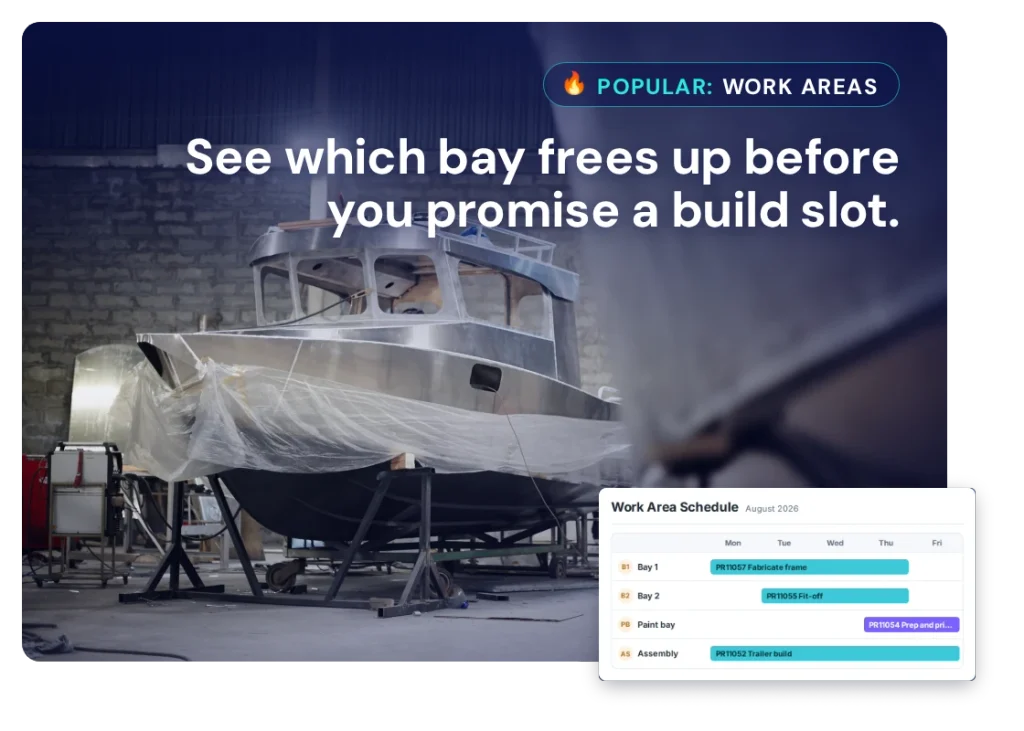
See what is coming up, what is underway and what is waiting.
Timesheets
Get the team’s hours onto the jobs they actually worked on.
Purchasing
Keep what you buy against the job it was for.
Job Costing
See what you allowed for and what the job is actually costing.
Automations
Handle the reminders, approvals and handovers that are easy to forget when things get busy.
Reporting
Look back at jobs and see what actually happened.
Fit
Will it work for the way we do jobs?
Fair question. Every business does things a little differently. These are the questions that usually matter most.
“Our builds run for a long time.”
That is fine. Keep adding the real hours, purchases and changes as the build moves along.
“Every boat is custom.”
Each build can carry its own parts, stages and costs.
“We use a lot of subcontractors.”
Keep their costs with the same job as your own labour and purchases.
“Customers change things during the build.”
Keep the change with the job so it does not disappear by the time you invoice.
Where it pays off
What boat builders use WorkGuru to fix
Each of these is a job to be done rather than a feature. The chips show the parts of WorkGuru doing the work.
Job Cost Control
Watch costs against the quote while the job is still running, not after it has been invoiced.
Powered by:
Labour Cost Tracking
See the hours that went on each job, and what those hours cost you.
Powered by:
Workshop Scheduling
Put work in front of the right people in the right order, and move it when things change.
Powered by:
Project Purchasing
Keep supplier orders and bought-in parts against the job they belong to.
Powered by:
Inventory Control
Know what stock you are holding, what is committed to a job, and what needs ordering.
Powered by:
Integrations
Keep using the systems you already have.
You do not need to replace your accounting or ERP system just to get the jobs under control. WorkGuru handles the job side – quoting, scheduling, timesheets, purchasing and job costs – and connects with the other systems you use.
FAQs
Questions boat builders ask
Our builds run for a long time. Does that cause problems?
No, but it changes what you watch. A build that runs nine months accumulates cost continuously against an estimate set before anything started, so the useful signal is the trend rather than the final number. Labour, purchases, subcontract work and materials record against the project throughout. The value of seeing a drift at month three is that something can still be done about it; at month nine you are only learning what to quote next time.
Every boat is custom. Can the system handle that?
Yes. Each build is its own project with its own stages, purchases and labour. Where structure repeats — hull, fit-out, systems, commissioning — a template gives you a starting shape without constraining the individual build. Custom boat building is one of the harder things to cost precisely, and the honest benefit is not prediction but accumulation: after a handful of builds you have real numbers for stages you previously guessed at.
We use a lot of subcontractors. Can we keep their costs on the build?
Yes. Subcontract costs are purchases raised against the project, so electrical, upholstery, rigging, engineering and specialist trades all land on the same job as your own labour. On a boat where subcontract content can rival internal labour, this is usually the difference between knowing the build’s real position and knowing only your own hours. There is a scheduling dimension as well. Specialist marine subcontractors are frequently booked weeks ahead and work across several yards, so a slip in your build does not simply move their work — it can lose the slot entirely. Keeping their engagement attached to the project, rather than in someone’s calendar, is what makes that dependency visible before it becomes a three-week hole in the programme.
Customers change things during the build. How is that handled?
Record the change on the build as it happens, with the original allowance still visible. Customer changes are constant in boat building, and they arrive conversationally — a call, a visit, a decision made standing on the deck. Capturing them at that moment is what makes them invoiceable. The most expensive habit in the trade is agreeing to a change on a Tuesday and trying to reconstruct it nine months later.
Can we track stages of the build?
Yes, by structuring the project into tasks for each stage and recording labour against them. Stage-level data is what eventually makes your estimating credible: you stop quoting a whole build from an overall figure and start quoting it from the actual hours that hull, fit-out and commissioning have taken on comparable boats. It also gives you a much earlier warning. A build that is twenty per cent over on hull hours is not going to recover it in fit-out, whatever anyone hopes, and knowing that at the end of the first stage is worth considerably more than knowing the total at handover. For yards that build a recognisable range rather than pure one-offs, a few completed boats’ worth of stage data is usually enough to make the next quote defensible rather than instinctive.
Can we manage long-lead items?
Purchase them against the build so the cost and the timing sit with the job. Engines, generators, electronics and specialist hardware often have to be ordered before the hull is finished, and having them attached to the project keeps both the money and the delivery date visible against the build they belong to rather than in a separate procurement list. The timing is usually the more dangerous of the two. A build programme that assumes a sixteen-week engine delivery and gets twenty-four does not fail at the engine — it fails three stages later, when everything downstream has been planned around a date that was never going to hold. Keeping the order on the project means the dependency is attached to the work it affects rather than living in a supplier email.
Can we keep drawings, specifications and survey documents with the build?
Yes, as project documents. On a build running the better part of a year, with a specification that develops as it goes, having the current document set attached to the job is a practical necessity rather than a filing preference. The risk on a long build is not losing documents, it is working from superseded ones — a shipwright building to a general arrangement that was revised two months ago produces work that has to be undone, and that cost lands on you rather than on whoever issued the revision. Keeping the current set with the job is the cheapest defence against that. It also matters at handover, when the owner wants the complete record and assembling it from four people’s inboxes is a week nobody priced.
Can we do progress claims against the build?
Progress invoicing is supported, which suits boat building because payment is normally staged against build milestones. The job stays open and accumulating while claims are raised against it, so what you have invoiced and what you have spent stay comparable. That comparison is the one that matters on a long build. A yard can be profitable on paper and still run out of cash halfway through a boat, because the milestones were set where they were easy to agree rather than where the money is actually spent — and the heavy spending on a custom build is usually earlier than the milestone schedule assumes. Seeing invoiced against incurred, stage by stage, is what turns that from a year-end discovery into something you can raise before signing the next contract.
Can we see the real cost of commissioning and sea trials?
Yes, if you give them their own tasks. Commissioning is where boat builds most commonly overrun, because the work is diagnostic rather than planned and it happens when everyone has stopped watching the budget. Costing it separately is how you find out whether your commissioning allowance has ever been right. The honest answer for most yards is that it has not been, because commissioning is quoted as a percentage or a round number rather than derived from anything. It is also the stage most exposed to other people’s problems: a fault in a bought-in system becomes your hours while the supplier works out whose fault it is. Recording those hours against the build is what eventually tells you which suppliers are genuinely cheaper and which only look it.
Does WorkGuru replace our accounting system?
No. It runs the build and connects to accounting for the financial side. The change worth having is that a nine-month build stops being a single large number you reconcile at the end and becomes something with visible structure while it is still in the shed. On a long custom build the accounting view is close to useless as a management tool — work in progress moves, deposits and progress claims distort the timing, and the month in which a boat is delivered looks spectacular for reasons that have nothing to do with how the build went. Stage-level job cost is the only view that tells you, while the boat is still yours to influence, whether this one is going the way the last one did.
See how WorkGuru would work for your boat building business.
We will show you how WorkGuru handles the jobs, and you can decide if it fits the way you work.