
Home / Industries / Conveyor & Materials Handling
For conveyor and materials handling manufacturers
Job Management Software for Materials Handling
Keep design, fabrication, bought-in components, site install and service work tied back to the same job.
- Local support, based in Brisbane
- Built for conveyor and materials handling
- No lock-in contract
The reality
Conveyor jobs touch a lot of different parts of the business.
No two jobs are exactly the same, but a few problems come up again and again.
The job starts in design and ends on site.
Engineering, fabrication and install hours all need to come back to one job.
Bought-in components matter.
Motors, gearboxes, belting, bearings and controls can be a big chunk of the cost.
Site measurements change things.
What looked right in the drawing may need another answer on site.
One late component holds the install up.
The steel can be ready and the job still cannot ship.
Commissioning finds the last few jobs.
Small changes at the end still take time and parts.
Service work interrupts project work.
A breakdown call can pull the same people off a build.
How it runs
Keep the job together from start to finish.
Same job record from the first quote through to the invoice. Nothing gets re-entered and nothing gets left in someone’s head.
01
Quote and design it
02
Order components
03
Fabricate the frame and structure
04
Assemble it
05
Plan the install
06
Install and commission
07
Capture changes
08
Invoice and close out
Proof
What it looks like in a real workshop
We are adding stories from conveyor and materials handling manufacturers. In the meantime, see how workshops like yours run WorkGuru.
Why conveyor and materials handling manufacturers choose WorkGuru
Know what is going on with the job.
Conveyor businesses often design, build, install and service the same equipment. WorkGuru keeps those parts of the job together so you can see the full cost, not just the workshop piece.
Are all the components here?
See what is ordered and what is still outstanding.
How many engineering and shop hours are in it?
Keep different teams against the same job.
What changed on site?
Keep install changes and extra work with the job.
What is stopping us shipping?
See the hold-up before the install crew is waiting.
How did the whole job go?
Compare the quote with the real design, build and site costs.
The tools you will actually use
Key features conveyor and materials handling manufacturers use
Every one of these has its own page. Follow the link if you want the detail on how it works.
Quoting / Estimating
Put down what you expect the job to need before you start.
Jobs
Keep the important information about the job together.
Scheduling
See what is coming up, what is underway and what is waiting.
Timesheets
Get the team’s hours onto the jobs they actually worked on.
Purchasing
Keep what you buy against the job it was for.
Job Costing
See what you allowed for and what the job is actually costing.
Automations
Handle the reminders, approvals and handovers that are easy to forget when things get busy.
Reporting
Look back at jobs and see what actually happened.
Fit
Will it work for the way we do jobs?
Fair question. Every business does things a little differently. These are the questions that usually matter most.
“We build and service equipment.”
Both can live as jobs in the same system.
“We do controls as well as fabrication.”
Keep those hours and purchases on the same project.
“A lot of our cost is bought-in components.”
That is exactly why keeping purchasing against the job matters.
“We have field crews and a workshop.”
Keep both sides tied back to the same job.
Where it pays off
What conveyor and materials handling manufacturers use WorkGuru to fix
Each of these is a job to be done rather than a feature. The chips show the parts of WorkGuru doing the work.
Workshop Visibility
Know what is on the floor, what is waiting, and what is holding things up.
Powered by:
Workshop Scheduling
Put work in front of the right people in the right order, and move it when things change.
Powered by:
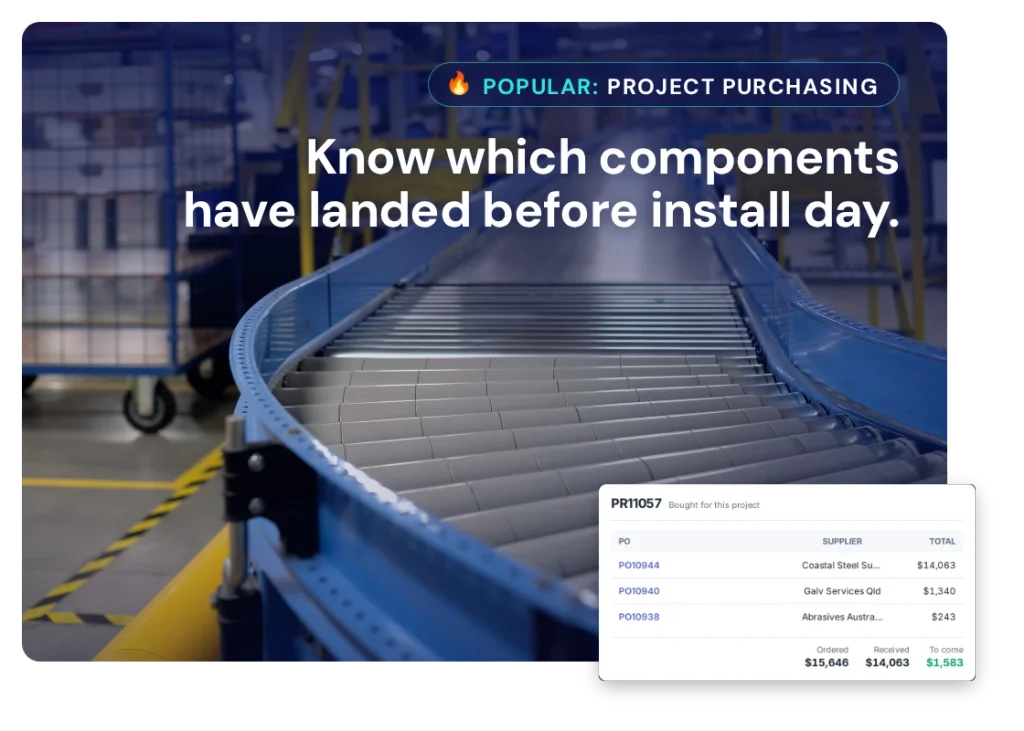
Project Purchasing
Keep supplier orders and bought-in parts against the job they belong to.
Powered by:
Inventory Control
Know what stock you are holding, what is committed to a job, and what needs ordering.
Powered by:
Faster Invoicing
Invoice off what was recorded on the job, so nothing gets missed and nothing sits waiting.
Powered by:
Integrations
Keep using the systems you already have.
You do not need to replace your accounting or ERP system just to get the jobs under control. WorkGuru handles the job side – quoting, scheduling, timesheets, purchasing and job costs – and connects with the other systems you use.
FAQs
Questions conveyor and materials handling manufacturers ask
“We build equipment and service it. Can both live in the same system?”
Yes, and keeping them together gives you something most materials handling businesses lack: the relationship between the two. Installations become service customers, and the equipment you built five years ago is the equipment you are maintaining now. Running builds and service work as jobs against the same customer — and, through asset management, against the same equipment — is what makes that history usable rather than anecdotal.
“A lot of our cost is bought-in components. How is that handled?”
Through project purchasing. Motors, gearboxes, drives, belting, idlers, bearings and control components go on purchase orders raised against the job, so the component cost sits with the system it went into. On materials handling the bought-in content routinely exceeds your own fabrication value, which changes where the commercial risk lives — you can run an efficient workshop and still lose the job to a drive package that was priced from a superseded supplier list.
“We do controls as well as fabrication. Can they be on one project?”
Yes, as separate tasks on the same job. That structure is worth insisting on, because controls and mechanical work behave nothing alike: mechanical scope is visible and estimable, while controls work expands quietly through integration, testing and whatever the customer’s existing plant turns out to be running. A job that reports one combined figure will consistently blame fabrication for overruns caused in the control cabinet.
“Can we manage design work as part of the build?”
Yes, recorded as its own tasks. Materials handling is design-led more than it appears — every installation is shaped by the building it goes into, the product being moved and the rate required — and that engineering is genuinely chargeable work. Businesses that treat it as part of winning the job end up carrying substantial unpaid design on tenders that never convert, and the only way to know how much is to have recorded it.
“We have field crews and a workshop. Can both go on the same job?”
Yes. Workshop fabrication and site installation record against the same project, ideally on their own tasks so the two remain comparable. For materials handling the site component is the volatile one, because installations happen inside operating plants with access windows, isolations and other trades. Keeping site hours separate is how you find out whether your installation rate has ever reflected working around someone else’s production schedule.
“Can we handle installations that happen during shutdowns?”
The work runs as a job like any other; what changes is the cost profile. Shutdown installations compress labour into a short window, frequently at penalty rates, with severe consequences for overrun. Record the hours as they happen against the job so the true cost of shutdown work is visible. Contractors who price shutdown installation at their standard rate are usually subsidising it out of the equipment margin.
“Can we track commissioning and rate testing?”
Yes, as tasks with their own hours. Materials handling equipment is bought to achieve a throughput, which means commissioning is not finished when the machine runs — it is finished when it runs at the specified rate with the customer’s actual product. That gap is where the hours go. Costing commissioning separately across installations is what eventually tells you which applications reliably cost more to prove than the quote assumed.
“Can we keep drawings, manuals and safety documentation with the job?”
Yes, as project documents. Conveyor and materials handling installations carry guarding, isolation and safety documentation that the customer needs at handover and their auditors ask for afterwards. Keeping it attached to the job rather than in a shared drive means the request two years later is answerable without finding whoever ran the project.
“Can we handle service and breakdown work on installed equipment?”
Yes, as jobs against the customer and, where you use asset management, against the equipment itself. Breakdown response on installed plant is commercially unusual because the customer’s cost of downtime dwarfs your invoice, which gives you considerable pricing latitude that most businesses do not use. Knowing your own cost to respond is the starting point for that conversation.
“Does WorkGuru replace our design or control software?”
No. Your design package models the system and your control software programs it. WorkGuru handles the job around both — the quote, the procurement, the fabrication, the site work, the commissioning and the margin. The join is the bill of materials and the programme: design determines what is needed, purchasing commits to it, and job costing records what the whole thing returned.
See how WorkGuru would work for your materials handling business.
We will show you how WorkGuru handles the jobs, and you can decide if it fits the way you work.