
Home / Industries / Structural Steel
For structural steel fabricators
Job Management Software for Structural Steel
Keep steel jobs together from estimate through detailing, purchasing, fabrication, delivery and installation.
- Local support, based in Brisbane
- Built for structural steel
- No lock-in contract
The reality
Steel jobs move around a lot before they are finished.
No two jobs are exactly the same, but a few problems come up again and again.
The drawings change.
A revision lands after material has been ordered or fabrication has already started.
Tonnage is easy to see. The little costs are not.
Consumables, bolts, freight, crane time, coatings and outside work all add up.
One late item holds the rest up.
A connection detail, plate, beam, drawing approval or coating delay can stop a whole section of the job.
Site dates move.
The install date changes, but the shop still has other jobs to get through.
Variations happen all the way through.
Extra steel, changed details, site work and rework all need to be captured.
Hours disappear across drafting, workshop and site.
You need the whole job cost, not three separate stories.
How it runs
Keep the job together from start to finish.
Same job record from the first quote through to the invoice. Nothing gets re-entered and nothing gets left in someone’s head.
01
Estimate it
02
Set up the job
03
Get drawings and approvals sorted
04
Buy the steel and bought-in items
05
Fabricate it
06
Send it for outside work
07
Deliver or install
08
Close out and invoice
Proof
What it looks like in a real workshop
We are adding stories from structural steel fabricators. In the meantime, see how workshops like yours run WorkGuru.
Why structural steel fabricators choose WorkGuru
Know what is going on with the job.
Structural steel jobs run through the office, detailing, the shop and often the site. WorkGuru keeps the hours, purchases, changes and job costs together so you can see how the whole job is going.
Which revision are we working from?
Keep job information and changes with the job.
What are we waiting on?
See whether the hold-up is drawings, material, coating, delivery or site.
How many hours are in it?
Pull drafting, shop and site time back to the same job.
Did we capture the variation?
Keep extra work with the job while it is still fresh.
How did the job actually go?
Compare the estimate with the real hours and costs.
The tools you will actually use
Key features structural steel fabricators use
Every one of these has its own page. Follow the link if you want the detail on how it works.
Quoting / Estimating
Put down what you expect the job to need before you start.
Jobs
Keep the important information about the job together.
Scheduling
See what is coming up, what is underway and what is waiting.
Timesheets
Get the team’s hours onto the jobs they actually worked on.
Purchasing
Keep what you buy against the job it was for.
Job Costing
See what you allowed for and what the job is actually costing.
Automations
Handle the reminders, approvals and handovers that are easy to forget when things get busy.
Reporting
Look back at jobs and see what actually happened.
Fit
Will it work for the way we do jobs?
Fair question. Every business does things a little differently. These are the questions that usually matter most.
“Our jobs run for months.”
That is fine. The job can stay open while the work, purchases and hours build up.
“We have office, workshop and site crews.”
Keep their time and costs against the same job.
“Drawings change all the time.”
Keep the job updated as the work changes instead of treating the original estimate as fixed.
“We already have estimating or detailing software.”
Keep it. WorkGuru is there to keep the job, hours, purchasing and costs together around it.
Where it pays off
What structural steel fabricators use WorkGuru to fix
Each of these is a job to be done rather than a feature. The chips show the parts of WorkGuru doing the work.
Job Cost Control
Watch costs against the quote while the job is still running, not after it has been invoiced.
Powered by:
Workshop Visibility
Know what is on the floor, what is waiting, and what is holding things up.
Powered by:
Workshop Scheduling
Put work in front of the right people in the right order, and move it when things change.
Powered by:
Project Purchasing
Keep supplier orders and bought-in parts against the job they belong to.
Powered by:
Quoting & Estimating
Price work off what jobs like it actually took, and get the quote back out the same day.
Powered by:
Integrations
Keep using the systems you already have.
You do not need to replace your accounting or ERP system just to get the jobs under control. WorkGuru handles the job side – quoting, scheduling, timesheets, purchasing and job costs – and connects with the other systems you use.
FAQs
Questions structural steel fabricators ask
Our jobs run for months. Can the system cope with that?
Yes, and long duration changes what you need from job costing. A job that runs twenty weeks accumulates cost continuously while the original estimate stays fixed, so the useful measure is not the final result but the trend. Labour, purchases, subcontract costs and outside processing land on the project as they occur. Seeing in week six that you are tracking fifteen per cent over on fabrication hours is actionable. Seeing it in week twenty is an autopsy.
Can office, workshop and site crews all book to the same job?
Yes. Detailing time, workshop fabrication and site erection hours all record against the same project. For structural steel this matters because the three are usually costed separately in the estimate and then blur together in practice. Structuring the job so each has its own task keeps the comparison honest, and it tends to expose the same thing on most jobs: the detailing allowance was optimistic.
How do we handle galvanising, blasting and painting?
As project purchases. Outside treatment is bought work and it also occupies calendar time, so keeping it on the job preserves both. On steel work the elapsed time is often the critical path — steel at the galvaniser is steel that cannot be erected — and having the purchase attached to the project is what makes that visible when the site is asking for a date.
Can we track variations and extras as the drawings change?
Yes, and on structural work this is usually where the margin is won or lost. Changes go onto the project as additional tasks, hours and purchases, with the original allowance still visible. The commercial reality of steel is that drawings develop after the contract is signed, and the fabricator absorbs a great deal of that development unless it is recorded at the time. The system does not chase the variation for you. It does mean you can show what changed rather than argue about it.
Can we manage material ordering against the job?
Yes. Section and plate bought for a specific job goes on purchase orders raised against the project, so the material cost sits with the steel it became. Where you hold stock sections, those issue from inventory to the job. Steel pricing moves, and having the actual purchase price on the actual job — rather than a standard rate — is what stops a whole year of quoting drifting away from reality.
Can we plan the workshop around bays and cranes?
Yes. Work Areas can represent bays, cranes, welding stations or the fabrication line, and work is scheduled against them. In a steel shop the binding constraint is often crane time or floor space rather than labour, and those are exactly the things a labour-only schedule cannot show you. A bay occupied by a half-finished portal frame is unavailable regardless of how many welders are free, and steel that cannot be moved because the crane is committed elsewhere stops the job just as effectively as a shortage of people. Scheduling against the physical constraint is also what makes the delivery conversation honest: you are not promising a date based on total shop hours, you are promising it based on the one resource every job has to pass through.
We already use detailing software. Where does that leave WorkGuru?
Your detailing package owns the model, the connections and the fabrication drawings. WorkGuru owns the commercial job: the estimate, the purchase orders, the labour, the costs, the variations and the invoicing. They are complementary rather than competing, and the handover point is usually the material list — detailing produces it, purchasing acts on it, and job costing records what it cost. Keeping that boundary clear tends to save arguments later. Detailing software is excellent at telling you what the job needs and has no view at all on whether the job made money; a job system is the reverse. The steel fabricators who struggle are usually the ones who expected one of the two to cover both, and ended up running the commercial side of a million-dollar contract out of a spreadsheet built around the material list.
Can we do progress claims on long jobs?
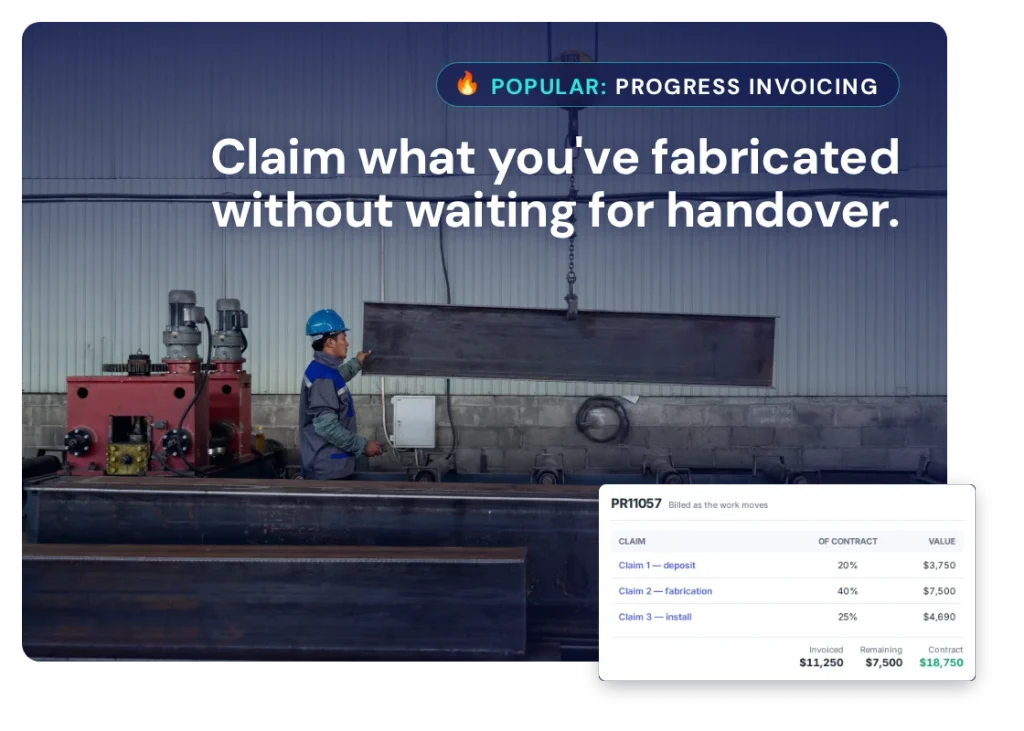
Progress invoicing is supported, which matters on steel because you are rarely paid once at the end. The job stays open and accumulates cost while claims are raised against it, so the comparison between what you have claimed and what you have spent stays visible rather than being reconciled at the end. manages project retentions during progress invoicing by using dedicated Non-Stock product line items to track values as a negative liability (asset) on the balance sheet. This workflow ensures that the progress claim matches what the client expects to pay while seamlessly mapping the withheld funds to your accounting software (such as Xero) without needing manual journal entries.
Can we track site erection separately from fabrication?
Yes, and you should. Give erection its own tasks so site hours, plant hire, travel and subcontract erection costs record separately from shop hours. Most steel fabricators who lose money on supply-and-erect jobs lose it on site rather than in the shop, and a job that reports one combined number will never tell you that. Site work also behaves differently from shop work in ways that matter commercially: it is weather-dependent, it is exposed to other trades running late, and an hour of standing around waiting for access costs exactly as much as an hour of erecting. Once erection is costed separately across a run of jobs you can usually see whether your site rate has ever covered what site work actually involves, which is a different question from whether the fabrication was priced properly.
Does WorkGuru replace construction project management software?
No. If your contract administration is heavy — formal RFIs, extensions of time, head-contract claims under a standard form — a dedicated construction platform will go deeper. WorkGuru runs the fabricator’s side: the job, the labour, the purchasing, the costs and the commercial result. Many steel fabricators run both, with the construction platform facing the head contractor and WorkGuru running the business.
Win more work, Streamline jobs, and make more profit
Start a free trial and manage your jobs, team, stock, and finances in one place.

Start a free trial now.
No credit card required. 14-days free period. Full access to every feature.