
Home / Features / Inventory & Stock Control / Production Jobs
Inventory & Stock Control
Build it for stock – and keep track of what went into it.
Build it once, cost it properly, and put it on the shelf as a product you can use or sell.
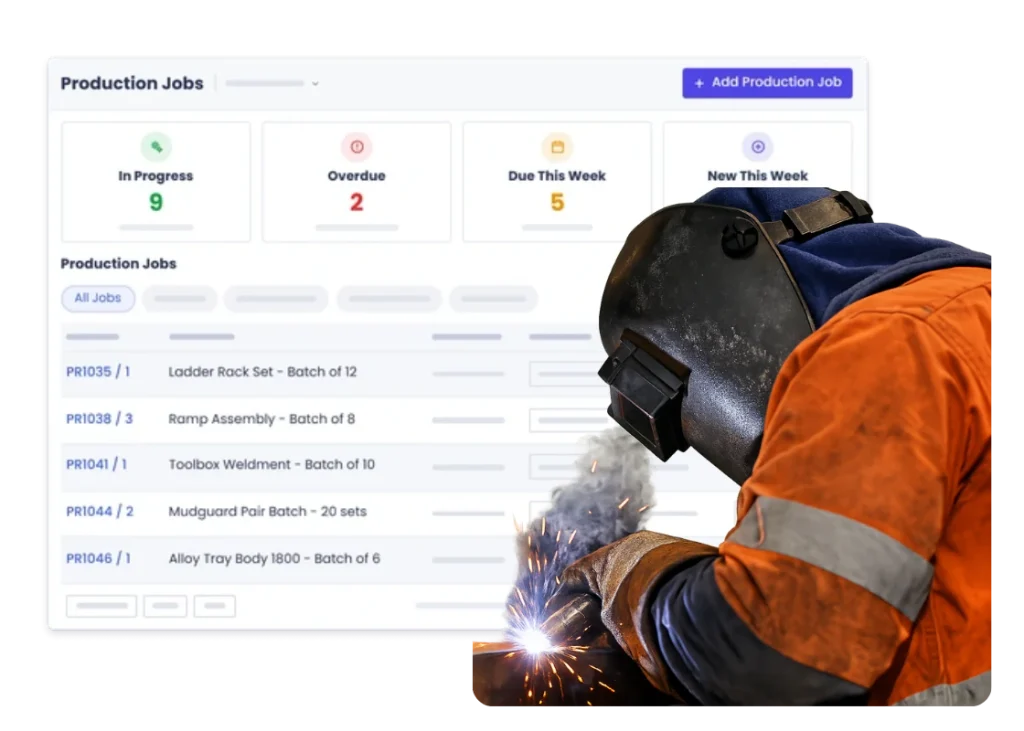
Overview
Not every build starts with a customer job.
A production job is how you make something rather than do something for a customer. You capture the same actuals you would on a project — the time, the materials consumed and the purchases made — but the output is different.
The fundamental difference is that a production job has no client. Where a project ends in an invoice, a production job ends in stock: the quantity you produced is added to stock on hand as properly costed product, ready to be used on a project later or sold.
That matters because it’s the only honest way to know what your own manufactured items cost. If you build sub-assemblies, weld up standard frames, or make anything you later draw on for jobs, the cost of that item is labour plus materials plus whatever you bought for it — not a figure someone worked out once and never revisited.
Once the item is in stock with a real cost against it, everything downstream gets more accurate. Quote using it and you’re quoting on what it costs. Use it on a job and the job carries the right material cost.
What’s inside
What you get
01
Production jobs
Give make-for-stock work its own job.
02
Component usage
Consume stock as the product is built.
03
Labour capture
Record the hours used to make it.
04
Scheduling connection
Plan production alongside project work.
05
Finished stock
Bring completed product back into inventory.
06
Repeat product setup
Use known products and job templates where that helps.
The reality
Why you need it
The labour disappears into overhead.
When you build something for stock and there’s nowhere to record it, the hours go into general overhead and the item’s cost becomes materials only. Every job that later uses it carries a cost that’s missing the largest part.
Nobody knows if it’s cheaper to make or buy.
It’s one of the more consequential decisions a workshop makes and it’s usually settled by instinct, because the true cost of making it has never been measured. Once production jobs carry real labour and material, the comparison becomes arithmetic.
The same sub-assembly gets rebuilt from scratch.
Not physically — commercially. Each time it’s quoted from someone’s estimate rather than from what the last one took, so the price drifts with whoever’s doing the quoting rather than with what it costs.
Stock appears out of nowhere.
Finished items get added to the shelf manually with a cost somebody typed in. That figure is usually last year’s, and it flows into every job that uses the item.
How it works
How it works
01
Create the production job
02
Add the components
03
Plan the work
04
Record what gets used
05
Record the labour
06
Finish the build
07
Receive the finished stock
Capabilities
What it does
Capability
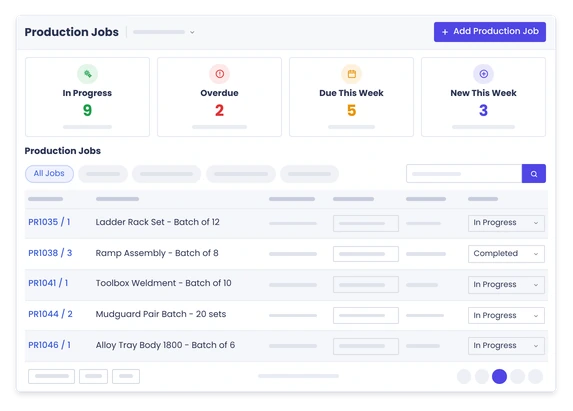
Production jobs
Give make-for-stock work its own job.
Capability
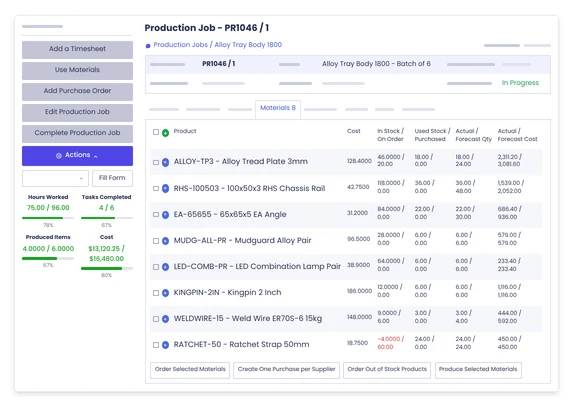
Component usage
Consume stock as the product is built.
Capability
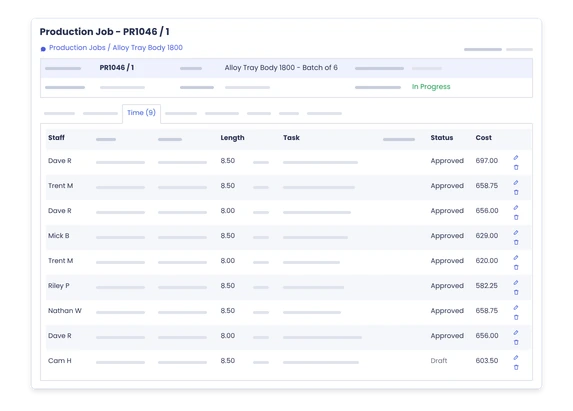
Labour capture
Record the hours used to make it.
Scheduling connection
Plan production alongside project work.
Finished stock
Bring completed product back into inventory.
Repeat product setup
Use known products and job templates where that helps.
What you get out of it
What changes
Give make-for-stock work a home
Separate production from customer project work without losing control.
Know what the build consumed
Keep component use tied to the production job.
Know what it took to make
Capture the labour behind repeat products.
Keep finished stock current
Bring completed products into inventory when the work is done.
-
Discovered their contract work wasn’t profitable.
We didn’t wanna pay 100 grand upfront for a program – but then we found WorkGuru.
Nick Mazzella, Administrator, Frontline Trays & Trailers
Fit
Will it work the way we do things?
“We are not a factory.”
Neither are most businesses using this. If you ever build something and put it aside to use or sell later — a standard frame, a sub-assembly, a batch of brackets — that’s production, whatever you call it. The alternative is that the labour disappears into overhead and the item’s cost is a guess.
“Most of our work is custom.”
Custom work is usually custom at the top and repetitive underneath. The finished trailer is one-off; the drawbar, the ramp assembly and the mudguard brackets may not be. Production jobs are for the repeated parts, and they don’t require the rest of your work to be standardised.
“We do small batches.”
Batch size doesn’t change anything. A production job for a batch of six works the same as one for six hundred, and small batches are often where costing goes wrong — the setup time is a bigger share of the cost, so a guessed figure is further out.
“We already know what these products cost.”
Sometimes that’s true. It’s worth testing against a couple of real jobs, because the number people carry is usually the material cost plus a rough allowance for labour, worked out at a point when steel was a different price. Production jobs give you the current answer instead of the remembered one.
By trade
Where this gets used
Works with
Connected features
Stock Control
Use components and receive finished products.
Product Management
Keep the product records behind the build.
Workshop Scheduling
Plan production around the rest of the floor.
Timesheets
Record the labour used to make stock.
Counter Sales
Sell the finished product when a customer buys it.
FAQs
Production Jobs questions
What is a production job in WorkGuru?
A production job captures the time, material usage and purchases required to build a product you’ll use later on a project or a stock sale. It looks like a project in that you’re recording the same actuals, but it has no client, and its output is finished stock rather than an invoice.
Can production jobs consume stocked components?
Yes. Materials drawn from stock are consumed by the production job and costed into what you’re building, using FIFO. So the cost of the finished item includes what its components actually cost, not a standing estimate.
Can labour be recorded against production work?
Yes. Time goes onto the production job the same way it goes onto a project, and that labour becomes part of the cost of the item produced. On fabricated items labour is usually the larger half of the cost, so leaving it out is what makes in-house parts look cheaper than they are.
Can completed production add finished items to stock?
Yes — that’s the point of it. Completing the production job increases stock on hand by the quantity produced, and that stock carries the cost built up from the labour, materials and purchases that went into it.
Do production jobs replace project jobs?
No, they sit alongside them. Projects are work you do for a client and end in an invoice. Production jobs are things you make for yourself and end in stock. Many businesses run both, with production feeding the parts that projects consume.
Can production work be scheduled with workshop jobs?
Yes. Production jobs can be scheduled alongside project work, which matters because they compete for the same people and the same floor space. Scheduling one without the other is how a workshop ends up double-booked.
Show us what you build for the shelf.
Bring us a repeat product or batch build and we will show you how the components, labour and finished stock can stay together.