
Home / Industries / Hydraulics
For hydraulics specialists
Job Management Software for Hydraulics
Keep hydraulic repairs, hose jobs, cylinder work and field jobs tied back to the right hours, parts and costs.
- Local support, based in Brisbane
- Built for hydraulics
- No lock-in contract
The reality
Hydraulic jobs can go from simple to messy pretty quickly.
No two jobs are exactly the same, but a few problems come up again and again.
You do not know what the cylinder needs until it is stripped.
The quote changes once you see the rod, barrel, seals and damage properly.
Parts come from everywhere.
Seals, fittings, hose, tube, valves and bought-in components all need to land on the right job.
A breakdown jumps the queue.
The workshop plan changes because a customer has a machine sitting dead in the field.
Small jobs pile up.
Hose jobs and quick repairs still need time, parts and invoicing, even if each one is small.
Field work and workshop work overlap.
The same team can be split between the bench, customer site and emergency call-outs.
The job is finished before the paperwork catches up.
That is when parts and extra hours get missed.
How it runs
Keep the job together from start to finish.
Same job record from the first quote through to the invoice. Nothing gets re-entered and nothing gets left in someone’s head.
01
Take the job in
02
Estimate what you can
03
Strip and inspect
04
Update the job
05
Order parts
06
Repair or build it
07
Record workshop and field time
08
Invoice it
Proof
What it looks like in a real workshop
We are adding stories from hydraulics specialists. In the meantime, see how workshops like yours run WorkGuru.
Why hydraulics specialists choose WorkGuru
Know what is going on with the job.
Hydraulic businesses juggle workshop repairs, parts, hose work and field jobs. WorkGuru keeps the job, time, purchases and costs together so the quick jobs and the big rebuilds do not disappear into the same pile.
What did we find when we stripped it?
Keep the changed scope on the same job.
What parts went into this?
Keep seals, fittings, hose and bought-in parts against the job.
Who has been on it?
Get workshop and field hours onto the same job.
What is urgent today?
See the breakdowns, planned jobs and what is waiting.
Did we charge for everything?
Keep the parts and extra work there when the invoice is raised.
The tools you will actually use
Key features hydraulics specialists use
Every one of these has its own page. Follow the link if you want the detail on how it works.
Quoting / Estimating
Put down what you expect the job to need before you start.
Jobs
Keep the important information about the job together.
Scheduling
See what is coming up, what is underway and what is waiting.
Timesheets
Get the team’s hours onto the jobs they actually worked on.
Purchasing
Keep what you buy against the job it was for.
Job Costing
See what you allowed for and what the job is actually costing.
Automations
Handle the reminders, approvals and handovers that are easy to forget when things get busy.
Reporting
Look back at jobs and see what actually happened.
Fit
Will it work for the way we do jobs?
Fair question. Every business does things a little differently. These are the questions that usually matter most.
“We do heaps of small jobs.”
They can stay simple. The point is still to get the hours and parts onto the right job.
“We also do emergency field work.”
That is common. Field jobs can be tracked the same way as workshop jobs.
“We do hose sales as well as repairs.”
Not every sale needs a big job. Use the job detail where it is useful.
“We cannot know the final cost up front.”
That is fine. Start with what you know and update it once you have stripped and inspected it.
Where it pays off
What hydraulics specialists use WorkGuru to fix
Each of these is a job to be done rather than a feature. The chips show the parts of WorkGuru doing the work.
Job Visibility
See where every job is up to without walking the floor or chasing someone for an update.
Powered by:
Job Cost Control
Watch costs against the quote while the job is still running, not after it has been invoiced.
Powered by:
Labour Cost Tracking
See the hours that went on each job, and what those hours cost you.
Powered by:
Project Purchasing
Keep supplier orders and bought-in parts against the job they belong to.
Powered by:
Inventory Control
Know what stock you are holding, what is committed to a job, and what needs ordering.
Powered by:
Faster Invoicing
Invoice off what was recorded on the job, so nothing gets missed and nothing sits waiting.
Powered by:
Integrations
Keep using the systems you already have.
You do not need to replace your accounting or ERP system just to get the jobs under control. WorkGuru handles the job side – quoting, scheduling, timesheets, purchasing and job costs – and connects with the other systems you use.
FAQs
Questions hydraulics specialists ask
We do a lot of small jobs. Is this too heavy for that?
Only if you make it so. A hose assembly is a customer, a couple of parts and a few minutes; it does not need tasks, documents or a schedule. The reason to have the small work in the system at all is aggregate — a hydraulics business doing sixty jobs a week from a counter rate card has no idea whether that rate card still works, and the answer only appears when the jobs carry their cost. Keep the quick ones quick and let the volume tell you something.
Can we handle hose sales as well as repairs?
Yes, and they are different transactions. A counter hose sale is closer to a product sale than a job, while a cylinder rebuild is job work with strip-down, inspection, parts and testing. Running both means you can compare them, which is worth doing because hydraulics businesses frequently subsidise one with the other without realising which way round it goes.
We cannot know the cost until we strip it. How does that work?
Open the job, quote and record the strip and inspect, then extend once the damage is visible. In hydraulics this is the normal condition rather than an exception — a cylinder that looks like a seal kit turns out to need a rod, a barrel hone or a new tube. The inspection hours are real work, and recording them gives you a factual basis for the conversation about whether the rebuild is worth doing at all, which on older equipment is frequently the honest advice.
Can we track parts against each job?
Yes. Seals, rods, tubes, fittings and components held in stock issue to the job, and anything bought specifically goes on a project purchase. Hydraulics carries an unusually wide and slow-moving parts holding, and the value here is as much about stock as about job cost — knowing what is actually being consumed is what stops a store full of items nobody has fitted in three years.
We do emergency field work. Can that be tracked the same way?
Yes. Field hours, travel and parts consumed record against the job wherever the work happens. Breakdown response is the part of a hydraulics business most likely to be underpriced, because the urgency is the customer’s and the inconvenience is yours — a call-out at four on a Friday costs you a great deal more than the labour rate suggests. Recording it is the first step to pricing it as the service it actually is.
Can we manage cylinder rebuilds through their stages?
Yes, by structuring the job into strip, inspect, machine, assemble and test. That granularity earns its place because the stages have very different cost behaviour — inspection is quick, machining depends entirely on what the inspection found, and testing either passes or sends you backwards. A rebuild costed as a single figure cannot tell you whether your quoting problem is in the assessment or the machining.
Can we track test results and pressure testing?
Testing can be a task with recorded hours, and results attach to the job as documents. Keeping the test record with the job matters commercially more than it might seem — a rebuilt cylinder that fails in service six weeks later becomes a warranty conversation, and a documented test result at handover is the difference between diagnosing the failure and absorbing it.
Can we keep equipment history for regular customers?
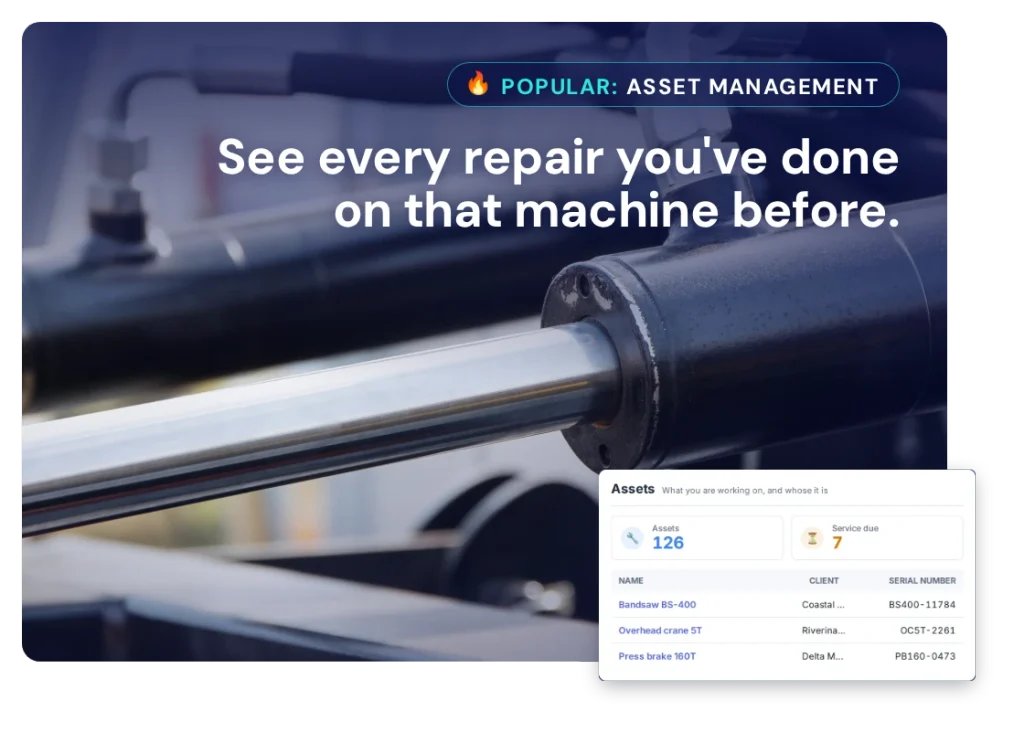
Asset management can carry the equipment context, so repeat work connects to the machine as well as the account. In hydraulics this is genuinely useful because failures repeat — the same cylinder on the same machine coming back twice in a year is telling you about the application rather than your workmanship, and that is a conversation worth having with the customer rather than quietly re-rebuilding it.
Can we see whether the workshop or the field work is making money?
Yes, provided both are recorded as jobs. This is usually the most useful split in a hydraulics business, and the assumption going in is almost always that the workshop carries the field work. Sometimes that is right. Where it is not, the cause is normally a workshop rate set years ago against a much cheaper parts basket, propped up by call-out work priced closer to its real value.
Does WorkGuru replace our accounting system?
No. It runs the jobs, the parts, the field work and the costing, and connects to accounting for invoicing and bills. For a hydraulics business the practical difference is visibility at the job level in a trade where the job count is high and each one is small — which is precisely where financial statements are least informative
See how WorkGuru would work for your hydraulics business.
We will show you how WorkGuru handles the jobs, and you can decide if it fits the way you work.