
Home / Industries / Custom Manufacturing
For custom manufacturers
Job Management Software for Custom Manufacturers
Run custom manufacturing jobs without pretending every order is the same.
- Local support, based in Brisbane
- Built for custom manufacturing
- No lock-in contract
The reality
Custom manufacturing is not a production line.
No two jobs are exactly the same, but a few problems come up again and again.
Every job has its own mix of work.
Different materials, different bought-in parts, different hours and different headaches.
The first one always teaches you something.
You find the hard bit once the job is already underway.
Engineering changes the job.
A design tweak can change material, machining, fabrication and assembly time.
Bought-in parts set the pace.
One supplier delay can leave a nearly finished job sitting still.
Small overruns repeat.
An extra hour here and an extra component there matter when it happens on every build.
The next quote needs the truth from the last job.
If you do not know what it really took, you are guessing again.
How it runs
Keep the job together from start to finish.
Same job record from the first quote through to the invoice. Nothing gets re-entered and nothing gets left in someone’s head.
01
Quote it
02
Set up the job
03
Plan the build
04
Order components
05
Make and assemble it
06
Record time and changes
07
Check the actual cost
08
Invoice and learn from it
Proof
What it looks like in a real workshop
We are adding stories from custom manufacturers. In the meantime, see how workshops like yours run WorkGuru.
Why custom manufacturers choose WorkGuru
Know what is going on with the job.
WorkGuru gives you one job to follow from quote through purchasing, labour, assembly and invoice. That matters when every job has its own mix of work and costs.
What did we allow for?
Keep the original job numbers easy to compare with reality.
What parts are we waiting on?
See what is ordered and what is still outstanding.
How many hours did this actually take?
Get the real labour back onto the job.
What changed after we started?
Keep design changes and extras with the job.
What should we quote next time?
Use what the last job actually took instead of starting from memory.
The tools you will actually use
Key features custom manufacturers use
Every one of these has its own page. Follow the link if you want the detail on how it works.
Quoting / Estimating
Put down what you expect the job to need before you start.
Jobs
Keep the important information about the job together.
Scheduling
See what is coming up, what is underway and what is waiting.
Timesheets
Get the team’s hours onto the jobs they actually worked on.
Purchasing
Keep what you buy against the job it was for.
Job Costing
See what you allowed for and what the job is actually costing.
Automations
Handle the reminders, approvals and handovers that are easy to forget when things get busy.
Reporting
Look back at jobs and see what actually happened.
Fit
Will it work for the way we do jobs?
Fair question. Every business does things a little differently. These are the questions that usually matter most.
“We do not make the same thing every day.”
Good. WorkGuru is built around jobs, not just repeat production.
“Some jobs are one-offs and some repeat.”
Use the detail you need for each. Repeat jobs can be quicker to set up.
“Engineering changes things halfway through.”
Keep the change with the job so the new hours and costs do not disappear.
“We already have CAD and production tools.”
Keep them. WorkGuru handles the job and commercial side around the build.
Where it pays off
What custom manufacturers use WorkGuru to fix
Each of these is a job to be done rather than a feature. The chips show the parts of WorkGuru doing the work.
Workshop Visibility
Know what is on the floor, what is waiting, and what is holding things up.
Powered by:
Workshop Scheduling
Put work in front of the right people in the right order, and move it when things change.
Powered by:
Quoting & Estimating
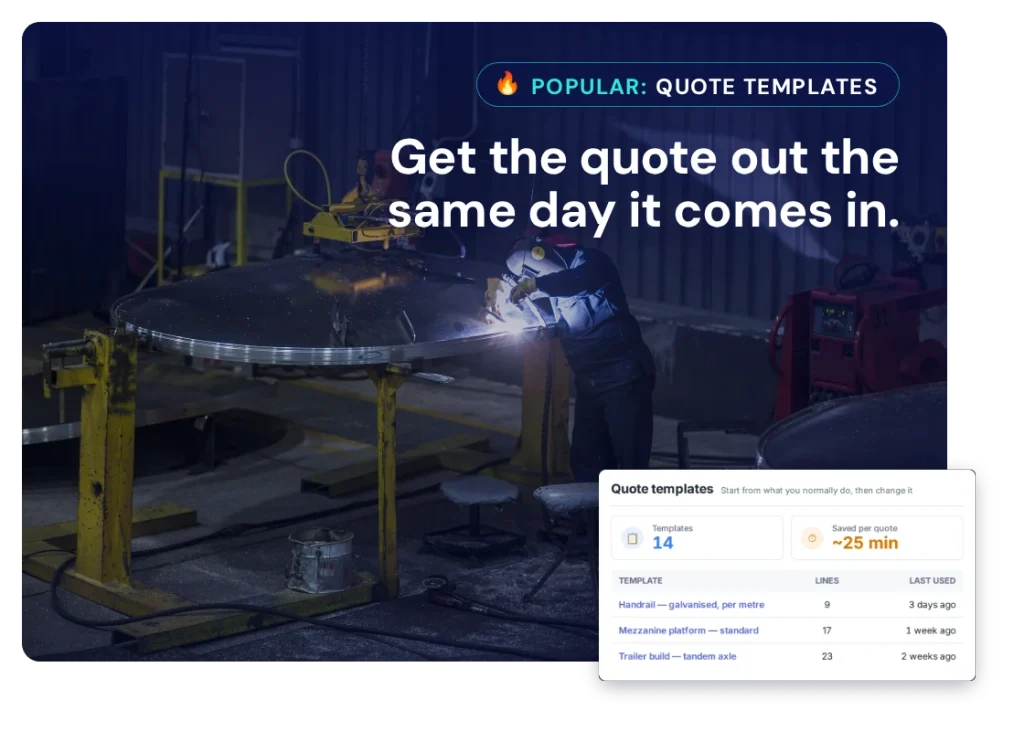
Price work off what jobs like it actually took, and get the quote back out the same day.
Powered by:
Project Purchasing
Keep supplier orders and bought-in parts against the job they belong to.
Powered by:
Inventory Control
Know what stock you are holding, what is committed to a job, and what needs ordering.
Powered by:
Integrations
Keep using the systems you already have.
You do not need to replace your accounting or ERP system just to get the jobs under control. WorkGuru handles the job side – quoting, scheduling, timesheets, purchasing and job costs – and connects with the other systems you use.
FAQs
Questions custom manufacturers ask
We do not make the same thing every day. Is that a problem?
No — that is the assumption the product is built on. Custom manufacturing is job work, not production, and the systems that struggle with it are the ones that assume a repeating part number. In WorkGuru the job is the organising unit: it carries its own materials, tasks, labour and purchases, and it does not need to resemble the last one. Where something does repeat, a template captures the structure without forcing the next job to match.
Some jobs are one-offs and some repeat. Can both work?
Yes, and the mix is normal. One-offs carry their own detail from scratch. Repeat work starts from a template built on what the job actually took last time, which is where custom manufacturers get the most estimating value — the second time you make something, you are quoting from evidence instead of memory. The mix itself is worth watching. Most custom manufacturers assume the one-offs subsidise nothing and the repeat work carries the business, and about as often it turns out to be the reverse: the repeat work was priced years ago against a first build that went badly, and has been quietly generous ever since, while the one-offs are underquoted because the engineering time is invisible. You cannot test either assumption without job-level cost on both.
Engineering changes things halfway through. What happens to the costing?
The change goes on the same job. Additional hours, revised material and further purchases accumulate against the project with the original allowance still visible. Engineering change is the defining commercial risk in custom work: it is legitimate, it is frequent, and it is usually absorbed because nobody recorded what it cost. Recording it does not win the argument automatically, but it makes the argument possible.
Can we see the true cost of a custom job?
Yes. Labour from timesheets, material issued from stock, project purchases and outside processing all land on the job and are compared against the estimate. The number that tends to surprise custom manufacturers is not material but engineering and setup time — the hours spent working out how to make the thing, which are real, substantial, and frequently priced as though they were nothing.
Can we plan capacity when every job is different?
Yes, through Work Areas and scheduling. The point is not a precise forecast — with custom work that is not achievable — but seeing where commitments converge. Most custom shops have one or two resources that everything passes through, and the useful question is not how busy the shop is but how much of what you have promised depends on that resource in the same fortnight.
Can we manage bought-in components alongside what we make?
Yes. Components bought for a job go on project purchases; stocked items issue from inventory. Custom manufacturing usually involves a higher proportion of bought-in content than people expect, and keeping it on the job is what prevents job costs from understating the real position. There is a second effect worth knowing about. When bought-in content is a large share of the job, your margin is exposed to supplier pricing in a way that a labour-heavy business is not, and supplier increases arrive quietly — a few per cent at a time, on individual lines, across dozens of jobs. Job-level purchase records are what let you see that happening within a quarter rather than discovering it at the end of a financial year when the overall margin has moved and nobody can explain why.
Can we keep engineering drawings and specifications with the job?
Yes, as project documents, which matters more in custom work than in production because the specification is frequently still moving. Having the current revision attached to the job — rather than in an email thread — is the difference between the shop building the right thing and the shop building the thing they were told about last month. Building to a superseded revision is one of the more expensive mistakes available in custom manufacturing, because it is usually discovered late and the rework is rarely recoverable from the customer. It is also entirely a process failure rather than a skills one: the drawing was updated, the update reached one person, and the shop was never told. Keeping documents with the job does not solve that on its own, but it removes the most common excuse for it.
We already have CAD and production tools. Where is the boundary?
CAD designs the product and production tools drive the making of it. WorkGuru runs the commercial job around both: quote, order, labour, purchasing, cost and invoice. The distinction is that your technical systems answer how, and WorkGuru answers what it cost and whether it was worth doing. That boundary is worth stating plainly because it is where a lot of software evaluations go wrong. Custom manufacturers are frequently sold a single system that claims to do design, production and commercial management, and the commercial half is usually the weakest part of it. Keeping the tools that already work and putting a job layer around them is generally a shorter path than replacing a CAD environment your engineers are fast in, for the sake of integration nobody has tested at your scale.
Can we quote more accurately over time?
That is the main long-term return. Each completed job leaves a real record of hours, materials and purchases, and the pattern across jobs is what improves estimating. Custom manufacturers usually discover their quoting has a consistent bias rather than random error — a category of work that is always underquoted — and a consistent bias is a fixable problem once you can see it.
Does WorkGuru replace our accounting system?
No. It runs the operational job and connects to accounting for the financial side. For custom manufacturing the practical gain is being able to answer which kinds of work are actually profitable, which is a question the ledger cannot answer because it has never known what a job was. The distinction is worth being precise about, because it is the source of a lot of confusion when businesses evaluate this kind of software. Accounting is complete and accurate and looks backwards at the whole business. Job costing is approximate, current, and looks at one piece of work while you can still change it. They are answering different questions, and a business that has only the first one is not short of numbers — it is short of numbers it can act on.
See how WorkGuru would work for your custom manufacturing business.
We will show you how WorkGuru handles the jobs, and you can decide if it fits the way you work.